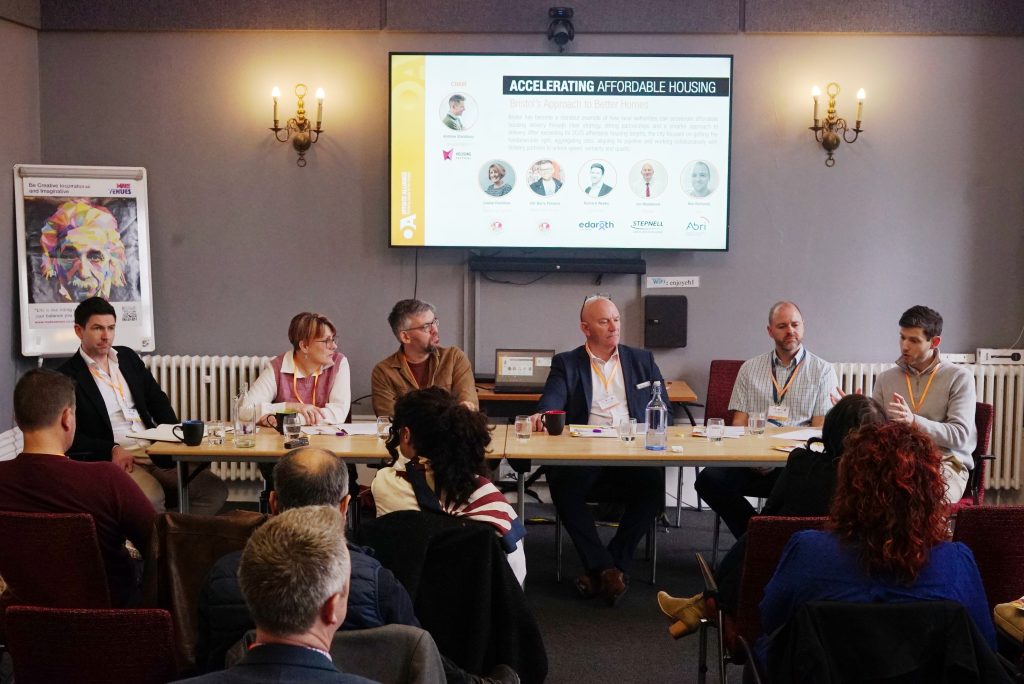
How can Offsite Construction Accelerate Affordable Housing?
In February, Offsite Alliance brought together local authority leaders, contractors, consultants and manufacturers to tackle one central question: How can offsite construction accelerate affordable housing delivery?
In partnership with Thorn Baker Construction, Housing Festival and Bristol City Council, the session moved beyond ambition to examine what genuinely drives delivery – from early contractor engagement and aggregated sites to aligned pipelines and repeatable supply chain partnerships.
The Panel Chair: Andrew Stansbury (Housing Festival) · Cllr Barry Parsons (Bristol City Council) · Louise Davidson (Bristol City Council) · Richard Weeks (EDAROTH) · Ian Woodward (Stepnell) · Ben Richards (Abri Homes)
Download the PDF version of this summary note here.
The Bristol Context
Bristol has emerged as an exemplar of how offsite construction can accelerate affordable housing delivery when the right partners, processes and ambition come together. Read about the scale of delivery across the city here.
This session was an opportunity to celebrate that progress, share lessons learned, and have an open conversation about the opportunities ahead. The discussion was deliberately practical and focused on real delivery rather than theory. You can watch the full discussion here.
The scale of the housing challenge
The discussion began with a reminder of why this conversation matters. As Cllr Barry Parsons, Chair of the Homes and Housing Delivery Committee, explained, Bristol is a vibrant and growing city, but but housing inequality is becoming more prolific here, as is also being experienced across the country.
“The impacts of people living in poor or insecure housing, for their health and wellbeing, are really considerable…so what do we need to do about this…we need more homes. And we need them yesterday, frankly.” – Cllr Barry Parsons, BCC
Recognising the advantages of offsite construction
Offsite construction is gaining traction as a way to deliver homes more predictably, with greater speed, quality and certainty. Richard Weeks, Technical Director at EDAROTH, and Ian Woodward, Senior Contracts Manager at Stepnell, highlighted the role offsite construction plays in maintaining consistency and speed in housing delivery on recent projects.
“We find that spending time with our supply chain partners dealing with MMC makes deliverability easier, the quality is much better and, working in climates in England, is a lot easier to deliver.” – Ian Woodward, Stepnell
In cities like Bristol, land availability is a major constraint. Many opportunities are smaller brownfield plots that can be difficult to develop using traditional construction methods due to issues such as local opposition, access and space constraints. Offsite construction can help unlock these sites while also reducing disruption to local communities.
The risks of and barriers to offsite construction
Despite its advantages, the offsite sector still faces real risks. For clients and housing providers, the consequences can be significant. Unlike traditional construction, failures in proprietary systems can leave clients exposed, and this risk can feel too significant. Ben Richards, Senior Development Manager at Abri Group, also drew the room’s attention to the hesitancy of lenders in funding schemes built utilising offsite construction methods:
“Lenders still have got this fear of a module, or a different system, that’s not traditional.” – Ben Richards, Abri Homes
There is, therefore, a need for greater collaboration and interoperability between systems to reduce these perceived risks. Andrew Stansbury, a Director at Housing Festival, brought up two examples here of recent projects in Bristol which were designed for an Offsite Construction partner that then folded, with the scheme then being picked up and completed by another modular provider. These examples provide a useful opportunity to learn lessons from in order to work towards more compatible systems and for collaborative partnerships between suppliers. The value of repeatable partnerships was also highlighted, as long-term relationships between clients, contractors and suppliers allow the sector to learn and improve delivery over time. With a clear pipeline of work, supply chains are more willing to invest in skills, innovation, and manufacturing capacity.
Louise Davidson, Head of Housing Delivery at Bristol City Council, also stressed the importance of considering offsite construction from the very beginning of the design process, rather than trying to retrofit it later. Instead, projects should start with the site and from there choose the most appropriate delivery method — whether that is panelised systems, modular construction or more traditional approaches.
Skills and the future workforce
The conversation also turned to the construction workforce. The wider construction sector faces a well-known skills shortage, and attracting new talent will be essential to meeting housing demand and offsite construction may help broaden the talent pool. How are we creating those pathways, collectively into training and education? The appetite for careers in construction is there, but the sector needs to provide clearer pathways into the offsite industry, to offer apprenticeships and competitive wages.
Conclusion
The discussion made one thing clear: accelerating the delivery of affordable housing will require more than any single solution. Offsite construction offers clear advantages in speed, quality and predictability, but its success depends on the wider ecosystem around it — from early design decisions and supply chain collaboration to skills development and long-term partnerships. Cllr Barry Parsons ended the session by bringing the conversation back to the importance of quality. For many residents in Bristol, new affordable housing developments are challenging long-standing negative perceptions because of previous failures around quality on projects.
Ultimately, that is what the sector is trying to achieve: homes people are proud to live in, delivered at the pace the country needs.
“We have a mission for this city — to deliver safe, warm homes that people can feel proud of, in communities where they can flourish.” – Cllr Barry Parsons
Key take-aways and next steps
- Embed offsite construction at the earliest stages of project design, rather than attempting to retrofit it later.
- Develop more compatible and interchangeable systems to reduce client risk if suppliers fail or projects need to change direction.
- Homes England to capture lessons from real delivery (two Bristol examples demonstrating compatible systems in particular), and translate them into practical, shared guidance for the sector.
- Strengthen collaboration across the supply chain—bringing clients, contractors, manufacturers and designers closer together to improve delivery, reduce risk and accelerate learning.
- Build clearer and more consistent project pipelines to give manufacturers and contractors the confidence to invest in capacity and innovation.
- Invest in skills and workforce development, creating clearer pathways into construction careers to address the sector’s skills shortage.
The feedback from attendees reflected the energy in the room:
“It was good energy. Open, honest, collaborative and such a wide range of views and experiences.” – Matthew Egan, By Design Group
“A fantastic session in Bristol… That level of honest dialogue is where real progress happens.” — Etopia
The conversation doesn’t stop at the door.
Want to go deeper?
This is what the Building Better: Community of Practice (BB:CoP) is all about — A space to keep the conversation going, continue challenging thinking and to share insights and real solutions. If you’d like to be part of it, join the Building Better: Community of Practice.